Crochet = pretty
Music in cavernous lobby = delayed reflection of sound
Musical chairs = violence
Monday, November 2, 2009


Tuesday, October 27, 2009
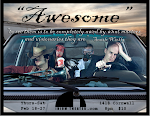
"Awesome" plays Holloween Show at The Moore

$20 at the door, 10pm, 21+, rumors of free Heineken and halloween hijinks.
Friday, October 16, 2009


Sign of the Eagle, Man

yesterday, i was walking to work when a guy with purple hair exited a cafe in front of me, took a look at me, and broke into a grin. "eagle," he said, "sign of the eagle, man. right on!"
Thursday, October 15, 2009
The Origins of The West
The West ends here, the pacific ocean, the West Coast (the “Left Coast” as they would tell me in South Carolina). We’re at the forward edge, the leading edge of Western-ness. The West moves West, bringing West with it, wiping out the non-West -- the stray bits of East that were here in the West before The West got here. The West sees these stray bits as like wild weeds, needing to be pulled up or tamed, paved over and smoothed out. The wabi-sabi tangles of vine and nest replaced by the ruled-line gleam of steel and plastic.
The West is new and the East is old. The East is tradition and balance. The West is progress and revolution.
So we know where the West goes. The harder question is “Where did it come from?” If West is new and East is old, just how new is the West? Where and when did it originate?
Recently I’ve been reading a book called The Spell of The Sensuous by David Abram, as well as listening to a podcast philosophy course by Hubert Dreyfus. A strange sort of story about the origin of The West begins to emerge.
Socrates, Plato and Aristotle lived in Classical Greece – a good place to start when looking for the origin of The West. Before that was Homeric Greece. And the transition from Homeric Greece to Classical Greece coincides with Greek culture’s being infused with a relatively new thing: the alphabet. It was perhaps 4 or 5 hundred years old, but only in Plato’s time did it start to become common for children (of a certain class and education) to be taught the alphabet, taught to read and write. Socrates was mostly illiterate. For who knows how long before that, knowledge was primarily transmitted orally, as songs and recited poems. People would memorize these things. Even in Plato’s time, much of the population still knew the entire Odyssey (all 12,110 lines of dactylic hexameter) by heart. Though it had been written down by Homer a couple of hundred years prior to Plato’s time, the written word until then had been an oddity, a gimmick, something only a certain elite knew about or cared about. It took a while to really take hold. So the Homeric Age of Greece was an oral culture, and people learned to memorize extremely lengthy poems and songs. These songs were manifestations of the embodied values of the Greeks at that time. The songs would slowly change as the culture changed. And for a long time, words were only sounds, sounds that came out of an individual person at a particular time. The introduction of the alphabet (which came from the Semitic aleph-beth) changed things quite a bit. For one, some words could become permanent. The Odyssey would no longer change or grow, it was stuck in the words of Homer. It became like The Bible –a holy work that was blasphemous to suggest editing or updating. Secondly, for the first time, words could be separated from the speaker of the words. (Note: the distinction between words and the ideas they expressed was not something comprehensible to the Greeks at this time, and would not become comprehensible for hundreds of years. That’s why you find so many use-mention mistakes in Aristotle, for example.) Thanks to the alphabet, you could write down something that someone said and instead of talking about what this particular person said, you could forget about the person and just talk about the ideas/words themselves. And at the same time, while certain words (like The Odyssey) became “stuck” by being written down, the alphabet invited one to look at, and possibly change words. Written words enabled a certain kind of abstraction that was impossible before. In the oral tradition, you could talk about Justice only in the context of memorized stories and songs that would give one concrete examples of justice. Justice lived only in specific just actions and just people. But now you can write down the word ‘Justice’ and ask: What is Justice itself? And this was precisely the kind of question that Socrates asked, and the kind of forced introspection and self-examination that got him killed. But Plato took up the cause and wrote down everything that Socrates said. And so the idea of putting abstract ideas squarely in view – only possible thanks to written language and the change in thinking they enabled – brought about a radical change in culture and value. Whereas before, the values of the culture, the way that it sees itself, what the culture thinks a human being really is – before, these things did not exist in the form of explicit beliefs of the culture, they were simply embodied in the actions and stories (and the actions of Odysseus and others in the stories). Now they can be made explicit as written words and then debated. We can examine our concepts, analyze them, decide that they contain implicit assumptions that we no longer agree with, and rebel from them. This is the beginning of philosophy, and the beginning of The West: Progress over Tradition.
Furthermore: Words used to be natural sounds. Words were the bark, the purr, the chirp of man. The pre-alphabetic man is an animal continuous with the other animals. He is part of the living buzzing, chirping, barking world. But when his words begin to have lives of their own apart from their being the sounds of flapping flesh and air, man follows them away from the corporal, away from the physical animal body and into the realm of abstract ideas. His sense of self, his very identity is changed: he is now a thinker, one who trades in concepts and ideas. His body is now seen as a mere container for his true essence. He leaves the animals and the rest of non-human nature behind. Later this way of thinking about what it is to be human is picked up by Descartes ("I think therefore I am") and then brought to the center of Enlightenment thinking by Kant: To be human is to be a thinker who can transcend his animal nature. You may have animal wants, animal desires, but because you are human, you don’t have to act on them. This is why you, but none of the non-human animals, have free will. And this is why the humans are the natural masters of the earth. The essence of Humanity in The West is freedom from and supremacy over one’s animal ingredients. Humanity in The West is the freedom of self-determination. Man is only accidentally corporeal, only accidentally embodied, only accidentally flesh. His true nature is Mind (over matter). He rises above and tames his own physical nature and so entitles himself to tame all of nature and bend it to his will. He is the master of the corporeal world.
Another thread in all of this has to do with the thinning of Gods that started to happen in Classical Greece. Way back in Thales’ time (well before Socrates), it was said that “All is full of gods”. There were many many gods. Indeed, gods were in everything and were everywhere. This brought with it a certain kind of respect for everything in the world around you. The spiritual world was not somewhere far away, it was all around you all the time. Abram marks this as a (perhaps the) crucial difference between indigenous cultures with an oral tradition and our modernity, our West: It is only in The West that there is a distinction between the natural and the super-natural, between the world of the flesh and the world of the spirit. In the non-western non-alphabetic cultures Abram studies, all is (still) full of gods. And this does not mean that, say, a tree has a god living inside of it, as an interloper from another world. Rather, the tree itself (with nothing weird added), is already a spiritual, living, being. This is contrasts starkly with the Judeo-Christian God who lives in another world entirely. In the Judeo-Christian way of seeing things, the world that humans live in (while alive) is essentially a world of deterministic biological machines and non-living swarms of particles whose motions are completely determined by the inviolable laws of nature. It is the world of science and rationality, completely separate from the world of spirituality. (“We are spirits in the material world,” says Sting.) The Westerner must grapple with this bifurcation of worlds constantly: In what ways do religion and science conflict with each other? Are miracles scientifically impossible? How does the non-physical soul/mind interact with and control the physical body? These are questions that do not make sense in the pre-Western world, nor in the world of the indigenous people whose oral traditions Abram studies. (The post-theist Westerner solves this neatly by vanishing the spiritual altogether: It is not in this world, and it is not in any other world either.)
Thursday, October 8, 2009
the Fort
we'll be at ft. warden making the merry magic in a chamber 40 seconds wide. be sure to wear shoes and dress warmly. don't run out of oxygen.
Thursday, October 1, 2009
Last Night's Dream
We're living in a little cabin on the ocean. I take a walk down the beach and I see something partially buried in the sand -- it looks like a really long white t-shirt. Dan Ackroyd comes out (he lives in the cabin next to us) and explains that it is actually a ghost -- a hot young lady ghost that he had a little fling with one summer many years ago. And because he was dating her (and because she was a GHOST), he let her influence the writing of Ghostbusters II. Ah! So THAT'S why that movie was so awful. Dan is telling me: Remember, just because your girlfriend is a ghost and you're writing a movie about ghosts, doesn't necessarily mean she is a good writer. Thanks Dan. I'll keep that in mind.
Wednesday, September 23, 2009

Tuesday, September 22, 2009

Thursday, September 17, 2009
Anyone have an old mandolin I could borrow?

or buy? for CHEAP?
It can have holes in it. or cracks. It can have your "Meat Is Murder" bumper sticker on it. It doesn't have to sound that great. I don't care, as long as it is basically, pretty much, mostly playable.
I just want it 'cause they're useful to have on hand when you're trying to write a song that has a mandolin in it.
anyone? anyone?
The Boy From Lam Kien Salon
I can't remember if I ever posted this. It's old now, but I still kinda like it.
Wednesday, September 16, 2009
A helpful chart

I put together this chart for people who need help understanding their place in the scheme of things.
The "Awesome" Movie: it's not real, dawg
But the treatment is here...
SCENE ONE: The End
Seven hooded figures roll out a large sheet of paper detailing the end credits. When the paper runs out, they begin to chalk - in real time - more credits on the sidewalk. The chalk breaks. They begin to spell out more credits in blood. They are questioned by cops on segways, who ask where the blood came from. Unable to answer, the seven hooded figures are brought into the police station.
SCENE TWO: Doin' Time
The words "Doin' Time" are written in log font. For 7 minutes.
SCENE THREE: Jailbreak!
In the slammer, the seven hooded figures meet seven inmates wearing out-of-date striped uniforms. Together, they plot an escape route through the walls of their collective cells. An entire musical number begins but is thwarted by seven guards who beat the 14 inmates with bassoons.
SCENE FOUR: Seven Brides for Seven Brofficers
The seven guards return home that night, complaining to their seven wives that work was difficult. The wives, played by men, are angry that their spouses haven't noticed their bitchin' haircuts, and they beat the seven husbands with trombones.
SCENE FIVE: Phantom Orchestra
That night, while the seven husbands and seven wives sleep in separate rooms, the seven trombones become possessed by demons/daemons and begin playing a jaunty jig. They float out into the street and down to the local pub, where a band of seven musicians is playing the exact same jig. Dejected, the possessed trombones wander down an alley and shoot up heroin.
SCENE SIX: A Band
The seven-member band finishes their set and packs up their seven vans with gear. Then they push all seven vans together and lash them across with rope. This proves ineffective on the freeway and a horrible crash ensues. Blood everywhere (they hit a blood truck).
SCENE SEVEN: Denouement
The blood is found by seven hooded figures who have just broken their chalk and are looking for something else to write the end credits with.
FAAAAAAAAAAAAAAAART
Saturday, September 12, 2009

Wednesday, September 9, 2009
Happy Number 9 Day
Queued up with some other nerds at Easy Street last night 'round midnight to purchase one of only 10,000 remastered Beatles in Mono box sets like a good little consumer. I've only made it through side one of Revolver, but so far I agree with Geoff Emerick.
Monday, September 7, 2009
LewIMAXs and ClIMAXrk
that wasn't a very good movie. i could see roads in the footage they shot of the journey west. pretty sure i saw a QFC sign too.
Thursday, September 3, 2009
West
Poor Isaac Ebey (1818-1857). Wikipedia tells us that he was the first permanent white resident of Whidbey Island. Also that he got his head CUT OFF by some pissed off Haida Indians who lived over on Vancouver Island. A couple of years later, after much haggling, the Indians returned what was left of the head (mostly the scalp and some ear parts) to Issac's brother Winfield.
There's a hiking trail that goes by the old Ebey place. It's supposed to be quite pretty.
There's a hiking trail that goes by the old Ebey place. It's supposed to be quite pretty.
Tuesday, September 1, 2009
Weekend Roundup
He eats a cookie and stands on a couch. You never give me your money. When you ask interesting questions, the man in the suit honors your requests. Two become one three times. (They do the high chair dance in 5/4.) A contemporary look at mark making makes a driveway for talented friends to rub eyeballs in a melted vanilla sunday. Four march to buckhorn. One stung twice by hornets chasing them up the mountain, past a plane crash into the remnants of a Masonic password.
Subscribe to:
Posts (Atom)


 Posts


