
GALLERY 1412

First to go - immediately for some people - is drinkable water. Anyone living in a high-rise apartment, where water has to be pumped to reach them, would be cut off straight away. For the rest, drinking water will still come through the taps for maybe half a day. With no electricity to pump water from reservoirs, there is no more after that.
There is simply no electrically powered transport: no trains, underground or overground. Our just-in-time culture for delivery networks may represent the pinnacle of efficiency, but it means that supermarket shelves would empty very quickly - delivery trucks could only keep running until their tanks ran out of fuel, and there is no electricity to pump any more from the underground tanks at filling stations.
Back-up generators would run at pivotal sites - but only until their fuel ran out. For hospitals, that would mean about 72 hours of running a bare-bones, essential care only, service. After that, no more modern healthcare.
The truly shocking finding is that this whole situation would not improve for months, maybe years: melted transformer hubs cannot be repaired, only replaced. "From the surveys I've done, you might have a few spare transformers around, but installing a new one takes a well-trained crew a week or more," says Kappenman. "A major electrical utility might have one suitably trained crew, maybe two."
Within a month, then, the handful of spare transformers would be used up. The rest will have to be built to order, something that can take up to 12 months.
Even when some systems are capable of receiving power again, there is no guarantee there will be any to deliver. Almost all natural gas and fuel pipelines require electricity to operate. Coal-fired power stations usually keep reserves to last 30 days, but with no transport systems running to bring more fuel, there will be no electricity in the second month.
Nuclear power stations wouldn't fare much better. They are programmed to shut down in the event of serious grid problems and are not allowed to restart until the power grid is up and running.
With no power for heating, cooling or refrigeration systems, people could begin to die within days. There is immediate danger for those who rely on medication. Lose power to New Jersey, for instance, and you have lost a major centre of production of pharmaceuticals for the entire US. Perishable medications such as insulin will soon be in short supply. "In the US alone there are a million people with diabetes," Kappenman says. "Shut down production, distribution and storage and you put all those lives at risk in very short order."
The NAS puts the recovery time at four to 10 years. It is questionable whether the US would ever bounce back.


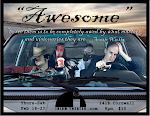
 First of all, we've got a brand (spanking) new thing by Sgt. Rigsby And His Amazing Silhouettes, called The Epic of Gallus Domesticus. If you don't know what I'm talking about because you blacked out after the last Sgt Rigsby show you saw, maybe the picture there will remind you.
 Annex Theater's own writer/raconteur Bret Fetzer (left) directed the show, and will also be on hand to read a few BRAND NEW fairy tales written just for this very special special evening.
 Then we have punk marimba virtuoso Erin Jorgensen (right) who will debut new arrangements of Appalachian mountain gospel songs. I don't know how she does what she does, but it blows my mind every time. I think it has something to do with her yarn-ball mallets. Man would my cats love to get a hold of those.
 And Erin will be bringing with her the sweet soul-saving singing of Sunday Services. Allah be praised!
 AND!!!!! (Saving the best for last!) This show also features the unparalleled puppetry talents of the inimitable BEN LAURENCE. (Pictured here in last year's Broadway smash, the screwball action mime-opera comedy, Every Which Way But Noose.)

Writing Lyrics
Topic – what’s the song about?
• Beware of hackneyed, over-done topics:
---> How about a misogynistic rap song about how you’re the best rapper, the toughest gangster and how all women love you? BORING!
---> Love songs? Well, 90% of pop music is about love and relationships, so if you’re going to do a song on that topic, you’d better have a new take on it.
* Think about topics that you don’t often hear in songs. (This is one of the great things about Kunjabunja titles – they often make you write about topics you’d never think to write a song about.) I’ve never heard a song about getting stuck in an elevator with someone who hums along with the elevator music, or a song about why hermit crabs are cooler than giant squid, or a song about the Pythagorean Theorem, or a song about the Financial Aid Form, or a song about a guy who always uses orange (never yellow or green) highlighter pens, etc. etc. etc. You can take a real story and change some of the facts (a song about George W. Bush in 2004 deciding to pull out of the Iraq War, or do a fictitious story about what happened behind the scenes in a real event (e.g., a song about John Wilkes Booth hiding in the Ford Theater, waiting for Abraham Lincoln to show up so he can assassinate him, but he’s really got to pee, and he’s not sure how long he can hold it), or just do a song about a real event, but concentrate on some tiny obscure detail of it (e.g., a song about the design on the tie that George Bush was wearing on 9/11).
Wordplay I – the sounds of the words:
• Rhythm – vary it up a little. Make one word long and slow and then cram a whole bunch of words into one space. Set up a pattern of rhythm and then break it.
• Rhyme – remember internal rhymes too; rhymes don’t always have to (or only) come at the end of a line. Sometimes not rhyming when a rhyme is expected is a powerful way of focusing people’s attention. (There’s a They Might Be Giants song that does that: “you're the only one here who can tell me if it's true. / That you love me and I love… me” – you expect to hear ‘you’ because it rhymes with ‘true’)
• Repetition – a good tool to emphasize something, but beware of beating your listeners over the head with something that is repeated too many times.
• Alliteration / Consonance – repetition of similar consonant sounds together, like “the sun settled on the south hill with sudden color”
• Assonance – similarity in sound between internal vowels in neighboring words, like, “Yo! Yo! You better go mow that fro you’re growing”
Wordplay II – the meaning of the words:
• Irony – sometimes it’s a great tool to say the opposite of what you mean.
• Metaphor – Instead of just coming out and directly saying what you want to say, why not say it indirectly with metaphor? But beware of using clichéd, obvious, or over-used metaphors.
• Imagery –This is crucial in good songwriting. But beware of using clichéd, obvious, or over-used images.
• Storytelling (beginning/middle/end).
• Call-backs – weaving in a theme. (Sometimes it’s fun to just pick some idea at random and challenge yourself to work it into the song at certain points. Like polar bears. Even if your song isn’t about polar bears.) Think about weaving in your theme in different ways each time.
• More than one thing going on. The lyrics mention one thing, but really you’re talking about something else. E.g., the song seems to be about how the spotted owl is disappearing, but really it’s about how all your friends are growing up, getting married and moving to the suburbs. That’s much more interesting than a song that’s just about the spotted owl, or a song that just comes out and baldly says “golly, all my friends are growing up, getting married, and moving to the suburbs.”
Other things to keep in mind:
• Brevity / the concise nature of songwriting. Remember that you don’t have to have complete sentences, or pay attention to the rules of grammar. Ask yourself – can I take out this word and still get across the general idea? Think of the famous William Carlos Williams poem: “so much depends upon a red wheel barrow glazed with rain water beside the white chickens.” It conveys so much with so little.
• Use your thesaurus. For each word, ask if there’s a better word, a less-used word, a more interesting word.
• Avoid cliché’s!
• Use specifics! Avoid generalities. This is very important. With one specific example, you can get an idea across succinctly.
• Show don’t tell. Instead of saying, “It was a very cold day”, say “I could see my breath puffing through my chattering teeth”
• Don’t spell things out for your listener. Let them figure it out for themselves. You just give them the clues.
• Set up a pattern and then break it. This could be with the rhythm, or rhyme scheme, or with ideas, or with the structure of the song.




 Posts
All Comments
Posts
All Comments


